Khóa học
IELTS Online
IELTS Online
Giảm đến 18%
Đăng ký ngay
Mục lục [Ẩn]
Bài đọc Swallows in Migration là một trong những bài kiểm tra toàn diện nhất về kỹ năng Reading IELTS, mang tính học thuật cao. Bài viết này sẽ cung cấp hướng dẫn giải chi tiết từng câu, từ những câu hỏi True/False/Not Given hóc búa đến các dạng Matching phức tạp, giúp bạn ôn luyện Skill Reading hiệu quả và nâng cao band điểm của mình.
| Bạn đang ở band IELTS bao nhiêu? Làm bài test miễn phí và nhận ngay lộ trình học cá nhân hóa. 👉 Đăng ký test IELTS miễn phí ngay |
Swallows in Migration
A. Every April, along with many other species of birds, the swallow arrives to spend the summer months in northern Europe, in Russia, Iran and parts of Siberia. Here it will breed and raise its young.
B. The swallow is well known for several reasons. Firstly, it is very distinctive, with its forked tail and characteristic acrobatic swooping flight. Secondly, it is very common, and, like its near relative the house martin, lives in close proximity to human habitation, at least in rural areas. It is, however, rarely to be encountered in towns or cities.
C. For centuries, people have observed swallows, noted their arrival and their patterns of feeding. In several countries, these observations have passed into the language as proverbs or sayings. In England, people comment on unpredictable late spring weather by saying, "one swallow does not a summer make". Similarly, "the swallows are flying low" was held to predict rainy, even stormy weather. There may be some truth in this observation, though it is the insects the swallows feed on that seem to be more susceptible to the fall in barometric pressure that heralds a storm. Insects keep low in these conditions, and so do the swallows that hunt them. At the end of the summer season, when the swallows are about to leave, they frequently flock together in large numbers on convenient high open perches, like roof ridges and telegraph wires. When people remark that "the swallows are gathering", they mean that autumn has arrived.
D. At some point in mid-September, the swallows leave together, usually all on the same day. One day there are thousands, the next there are none, and none will be seen again until the following spring. For centuries, this was a complete mystery to people. The Hampshire naturalist Gilbert White, writing in the late eighteenth century, believed that the swallows dived into ponds and rivers in autumn and remained in the bottom mud the whole winter, re-emerging the following spring. This idea seems extraordinary to us, but White was not a stupid man: many of his other observations of natural life were informed and accurate. In this case, however, he simply had no means of determining the truth and was forced to make a random guess. The idea that swallows migrate to central or southern Africa would have seemed as fanciful to him as his theory seems to us.
E. Although we now know that swallows migrate, there are still unanswered questions. Why do they go so far? Why not stay on the shores of the Mediterranean? The majority continue to equatorial Africa, and some even further south. Also, it appears that populations of swallows that have bred in different areas. Those from France, Germany and much of western Europe have mostly been traced to East Africa, Kenya or Tanzania for example. Above all, how does a bird weighing approximately twenty grams find its way across mountain ranges, ocean and desert to winter in the south, and then return the following year to the very location it was born, in some cases to the very same nest?
F. Birds can navigate by the Sun and are also able to detect the magnetic field of the Earth. Species that migrate at night are also able to navigate by the stars. By these means, they travel long distances. The close navigation that brings them back to the same field or nest appears to be related to memory of local landmarks imprinted on the minds of young birds as they crisscross the area in the weeks before departure.
G. Nevertheless, the journey is very dangerous. Long sea crossings, where there is little available food or water, are generally avoided. In western Europe, most swallows cross to Africa via the Straits of Gibraltar, or fly the length of Italy before tackling the relatively short crossing to Tunisia in North Africa. However, in storms they may be blown hundreds of kilometres off course. Exhausted swallows sometimes come to rest on ships way out in the Atlantic Ocean. They have to cross mountain ranges too, where again the weather may be unpredictable and food scarce. Along the coast of North Africa, many young swallows become the prey of Eleonora's falcons, which time their breeding to coincide with the migration of young birds southwards. But the most dangerous part of the journey is the crossing of the Sahara desert. Here, there is little food or water, sandstorms may delay and exhaust the already weakened birds, and many die. It is estimated that around 50 per cent of adult birds die, and up to 80 per cent of young birds, but enough survive to ensure the continuation of the species.
Questions 1-5
Do the following statements agree with the information given in the passage? In boxes 1-5 on your answer sheet write
TRUE if the statement agrees with the information
FALSE if the statement contradicts the information
NOT GIVEN if there is no information on this
1. The swallow is the only species of bird that migrates to spend the summer in northern Europe.
2. The swallow is easily noticeable because of its tail and the way it flies.
3. The swallow is frequently seen in cities.
4. The insects, not the swallows themselves, appear to predict stormy weather.
5. Swallows form larger flocks than other birds when they depart in the autumn.
Questions 6-11
Complete the sentences. Choose NO MORE THAN TWO WORDS from the passage for each answer.
6. In the past, the destination of the swallows in autumn was a ……………...
7. As White could not verify what happened to the swallows, he made a ……………...
8. Despite knowing that swallows migrate, we are still left with ……………...
9. Sometimes, swallows have been known to return not just to the same area, but even to the ……………...
10. Birds that travel by night can find their way using the ……………...
11. Bird navigation appears to be connected with the memory of ……………....
Questions 12 and 13
Choose TWO letters, A-F.
Which TWO of the following dangers faced by swallows during migration are mentioned in the text?
A. The Sahara desert
B. Long sea crossings
C. Lack of nesting places
D. Hungry sailors E Eleonora’s falcons
F. The crossing to Tunisia
>>> Xem thêm: Những sai lầm khi luyện IELTS Reading cần tránh và cách khắc phục
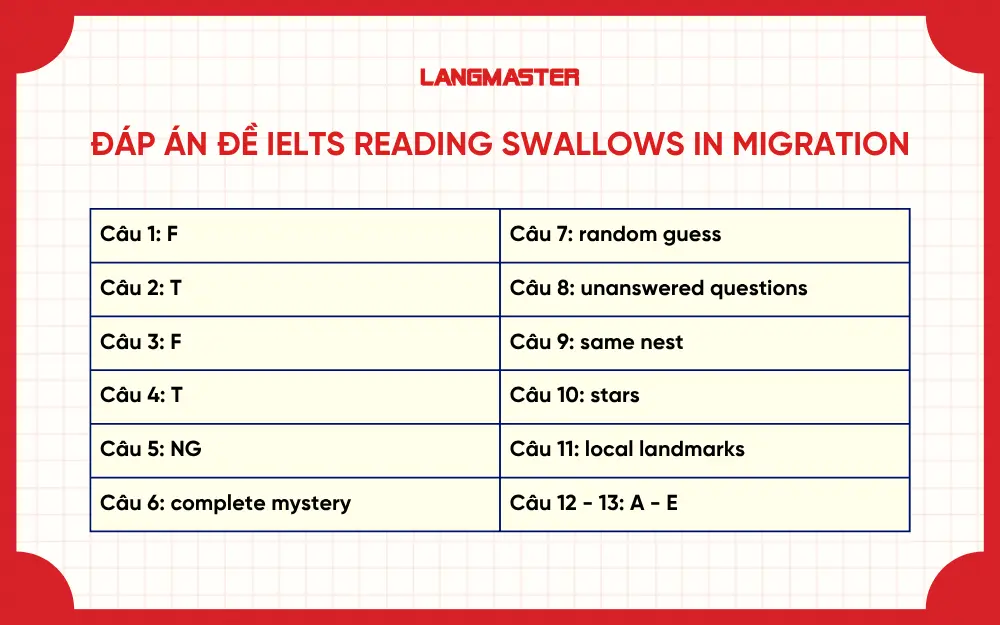
|
Câu 1: F |
Câu 7: random guess |
|
Câu 2: T |
Câu 8: unanswered questions |
|
Câu 3: F |
Câu 9: same nest |
|
Câu 4: T |
Câu 10: stars |
|
Câu 5: NG |
Câu 11: local landmarks |
|
Câu 6: complete mystery |
Câu 12 - 13: A - E |
>> Xem thêm: Giải đề IELTS Reading: How deserts are formed [Full answers]
Giải thích chi tiết:
Question 1
The swallow is the only species of bird that migrates to spend the summer in northern Europe. → FALSE
→ Trong đoạn A, bài viết nói: “Every April, along with many other species of birds, the swallow arrives to spend the summer months in northern Europe.” Cụm “along with many other species of birds” cho thấy có nhiều loài chim khác cùng di cư đến châu Âu, không chỉ riêng chim én.
→ Do đó, câu khẳng định “the only species” là sai.
Question 2
The swallow is easily noticeable because of its tail and the way it flies. → TRUE
→ Đoạn B: “The swallow is well known for several reasons. Firstly, it is very distinctive, with its forked tail and characteristic acrobatic swooping flight.”
Điều này hoàn toàn trùng khớp với nội dung câu hỏi. →Đáp án là TRUE.
Question 3
The swallow is frequently seen in cities. → FALSE
→ Đoạn B: “It is, however, rarely to be encountered in towns or cities.”
Tác giả khẳng định rõ ràng rằng chim én hiếm khi xuất hiện ở thành phố, nên câu nói “frequently seen” (thường xuyên thấy) là sai. → Đáp án FALSE.
Question 4
The insects, not the swallows themselves, appear to predict stormy weather. → TRUE
→ Đoạn C: “It is the insects the swallows feed on that seem to be more susceptible to the fall in barometric pressure that heralds a storm. Insects keep low in these conditions, and so do the swallows that hunt them.”
Nghĩa là côn trùng phản ứng với thay đổi áp suất trước, còn chim én chỉ theo sau để săn mồi. → Đáp án TRUE.
>> Xem thêm: Giải đề IELTS Reading Left or Right [FULL ANSWER]
Question 5
Swallows form larger flocks than other birds when they depart in the autumn. → FALSE
→ Đoạn C nói: “At the end of the summer season, when the swallows are about to leave, they frequently flock together in large numbers…” Bài không hề so sánh với các loài chim khác, chỉ mô tả hành vi của chim én.
→ Do đó, ta không thể kết luận “larger than other birds” → NOT GIVEN.
Question 6
In the past, the destination of the swallows in autumn was a complete mystery.
→ Đoạn D: “For centuries, this was a complete mystery to people.”
Câu hỏi: “the destination of the swallows in autumn was a …”, đúng với từ khóa “complete mystery”.
Question 7
As White could not verify what happened to the swallows, he made a random guess.
→ Cũng ở đoạn D: “In this case, however, he simply had no means of determining the truth and was forced to make a random guess.”→ Đáp án random guess.
Question 8
Despite knowing that swallows migrate, we are still left with unanswered questions.
→ Đoạn D tiếp theo: “Although we now know that swallows migrate, there are still unanswered questions.” →Cụm này trùng khớp hoàn toàn
Question 9
Sometimes, swallows have been known to return not just to the same area, but even to the same nest.
→ Đoạn D: “...and then return the following year to the very location it was born, in some cases to the very same nest.” → Đáp án same nest
Question 10
Birds that travel by night can find their way using the stars.
→ Đoạn E: “Species that migrate at night are also able to navigate by the stars.” → Đáp án stars.
Question 11
Bird navigation appears to be connected with the memory of local landmarks.
→ Đoạn E: “...appears to be related to memory of local landmarks imprinted on the minds of young birds.” →Đáp án local landmarks.
Question 12 - 13
A. The Sahara desert → Đoạn F: “But the most dangerous part of the journey is the crossing of the Sahara desert.” → Rõ ràng là A có trong bài.
E. Eleonora’s falcons → Cũng ở đoạn F: “Along the coast of North Africa, many young swallows become the prey of Eleonora’s falcons…” → Đáp án E có trong bài.
Các lựa chọn khác:
→ Vì vậy đáp án đúng là A và E.
| Học mãi mà IELTS không lên band? Học thử IELTS miễn phí cùng giáo viên 7.5+, chấm chữa lỗi sai ngay lập tức. 👉 Đăng ký học thử miễn phí ngay |
>> Xem thêm:
>> Xem thêm: Thời gian làm Reading IELTS: Chiến lược phân bổ và mẹo làm bài hiệu quả
Để đạt được band điểm IELTS cao người học cần một lộ trình luyện thi rõ ràng, môi trường giao tiếp thực tế và sự hướng dẫn từ giảng viên có chuyên môn cao. Trong số nhiều lựa chọn hiện nay, Langmaster được đánh giá là trung tâm luyện thi IELTS online uy tín tốt nhất dành cho người mất gốc cũng như người mới bắt đầu.
Khóa học IELTS Online tại Langmaster được thiết kế dựa trên giáo trình chuẩn đề thi thật, kết hợp học cá nhân hóa và phản hồi 1-1 từ giảng viên 7.5+ IELTS, giúp học viên phát triển toàn diện cả 4 kỹ năng: Listening, Speaking, Reading, và Writing.

Ưu điểm nổi bật của khóa học IELTS Online Langmaster:
Nếu bạn đang tìm kiếm khóa học IELTS online tốt nhất, phù hợp cho cả người mới bắt đầu lẫn người mất gốc, Langmaster chính là lựa chọn đáng tin cậy để bứt phá band điểm IELTS mơ ước.
Hãy đăng ký khóa IELTS online tại Langmaster ngay hôm nay để nhận được buổi HỌC THỬ MIỄN PHÍ trước khi đăng ký.
KẾT LUẬN: Như vậy, chúng ta đã vừa cùng nhau phân tích và giải chi tiết đề IELTS Reading Swallows in Migration. Bài viết đã làm rõ các kỹ năng cần thiết để tìm thông tin, nhận biết từ khóa và áp dụng chiến lược đọc hiểu hiệu quả. Hy vọng hướng dẫn này sẽ giúp bạn tự tin hơn khi làm bài và cải thiện điểm số Reading IELTS. Chúc bạn học tập hiệu quả và đạt kết quả cao trong kỳ thi IELTS sắp tới!





Các dạng bài phổ biến và tiêu chí chấm điểm IELTS Reading chi tiết nhất: Multiple Choice, Matching Information, Matching Headings,... và hướng dẫn chiến lược làm bài hiệu quả

Những sai lầm khi luyện IELTS Reading bao gồm: dịch từng từ, đọc hết cả bài, không đọc câu hỏi trước, không quản lý thời gian, không nắm vững kỹ năng paraphrase, viết sai chính tả
![Giải đề IELTS Reading: A brief history of humans and food [full answers]](https://langmaster.edu.vn/storage/images/2025/09/20/a-brief-history-of-humans-and-food-ielts-reading-answers.webp)
Giải đề thi IELTS Reading “A brief history of humans and food” kèm full đề thi thật, câu hỏi, đáp án, giải thích chi tiết, và từ vựng cần lưu ý khi làm bài.

Tổng hợp IELTS Reading tips hay nhất giúp bạn đọc nhanh, nắm ý chính và xử lý thông tin chính xác, tự tin đạt điểm cao trong kỳ thi IELTS.
![Giải đề IELTS Reading: The importance of law [Full answers]](https://langmaster.edu.vn/storage/images/2025/09/22/55.webp)
Giải đề IELTS Reading “The importance of law” kèm đáp án chi tiết, từ vựng quan trọng và bí quyết luyện thi hiệu quả để nâng cao band điểm.





Hơn 16 năm kinh nghiệm, đào tạo thành công 800.000+ học viên
Phương pháp giảng dạy hiện đại, học viên tiến bộ rõ rệt
Lộ trình học chuẩn quốc tế, phù hợp với nhu cầu thực tiễn
Giáo viên đạt chuẩn Quốc tế với chất lượng top đầu thị trường, giàu kinh nghiệm
Học online linh hoạt, cam kết đầu ra bằng văn bản